
Is this for you?
Manufacturers and exporters of pressure equipment and assemblies preparing an EU pressure-equipment conformity project based on actual product characteristics and intended use.
No matches.Browse services·Discuss your requirement
Industrial Compliance
Last reviewed: 2026-11-08
Exporting pressure vessels, heat exchangers, piping, boilers or pressure accessories to Europe? Most of them fall under the Pressure Equipment Directive (PED) 2014/68/EU. From Category II upward, a notified body must be involved. Tell us the equipment, its maximum allowable pressure, its volume or pipe size and the fluid it will hold. ConformArc will introduce you to a specialist who can confirm the category and route before you order materials or start welding.
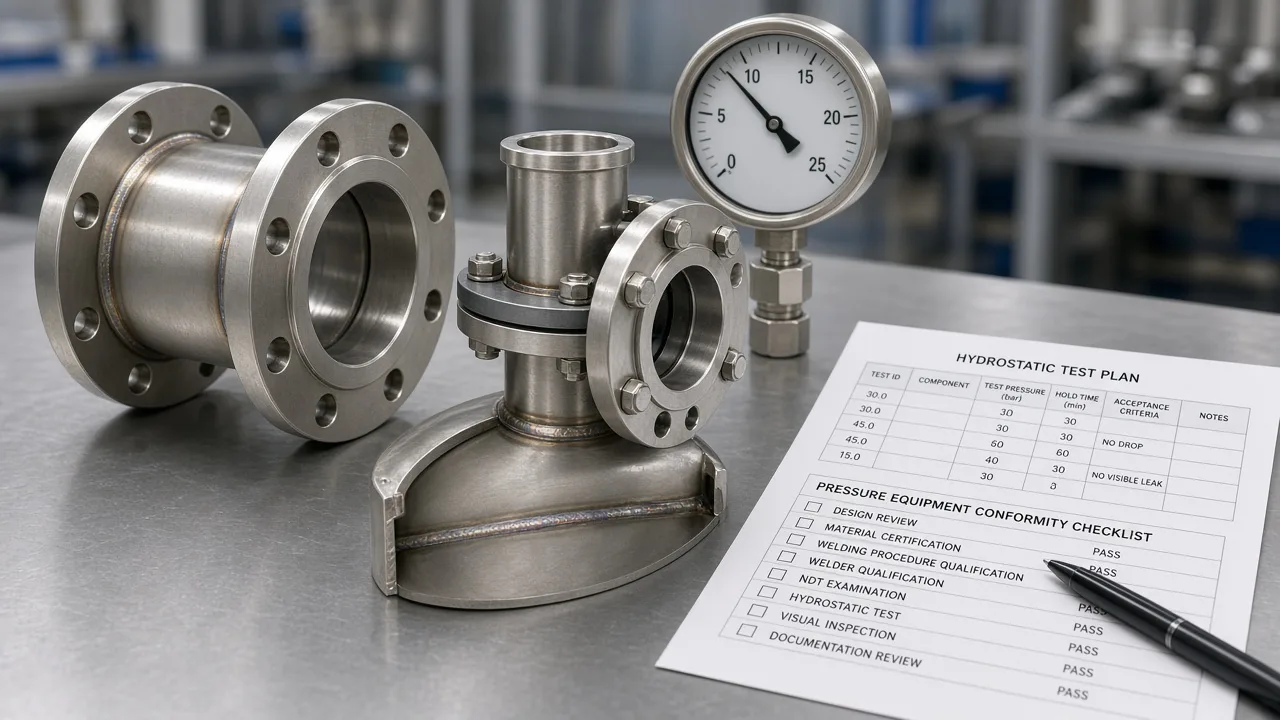
Manufacturers and exporters of pressure equipment and assemblies preparing an EU pressure-equipment conformity project based on actual product characteristics and intended use.
PED applies to the design, manufacture and conformity assessment of pressure equipment and assemblies with a maximum allowable pressure (PS) above 0.5 bar. That includes:
Some equipment is excluded or covered by other EU laws, for example simple pressure vessels, transportable pressure equipment and certain items covered by the Machinery or ATEX rules. A specialist must confirm the scope. If the equipment is also used in explosive atmospheres, see ATEX and IECEx certification support.
The category (I, II, III or IV) sets how much third-party assessment is needed. It depends on:
The thresholds are set in the conformity assessment tables in Annex II of the directive. Equipment below Category I is made under sound engineering practice (SEP). It must not carry the CE mark, but it still needs adequate instructions and manufacturer identification.
| Category | Typical conformity modules | Is a notified body needed? |
|---|---|---|
| SEP (below Category I) | Sound engineering practice | No. No CE marking |
| I | Module A (internal production control) | No |
| II | A2, D1 or E1 | Yes: supervision of the final assessment or of the quality system |
| III | B + D, B + F, B + E, B + C2, or H | Yes: EU-type examination and production or quality-system assessment |
| IV | B + D, B + F, G, or H1 | Yes: the highest level of assessment, including unit verification (G) or full quality assurance with design examination (H1) |
Where a notified body is involved, its four-digit number appears next to the CE mark. The module available to you also depends on the equipment type, so the specialist should confirm the permitted modules for your category.
Material and joining requirements are where many Indian projects lose time.
If your shop also works to ISO 3834 for welding quality, that helps but does not replace the PED requirements. See ISO 3834 welding quality.
| Equipment | Harmonised standard (examples) |
|---|---|
| Unfired pressure vessels | EN 13445 series |
| Metallic industrial piping | EN 13480 series |
| Water-tube boilers | EN 12952 series |
| Shell boilers | EN 12953 series |
| Safety valves | EN ISO 4126 series |
Designed to ASME? ASME-designed equipment can be placed on the EU market, but only if it meets the PED essential safety requirements. Materials, joining approvals and some design factors often need extra work. Ask the specialist to compare the two early.
A PED project is for the EU market. If the same equipment will be used in India, Indian rules such as the Indian Boiler Regulations (for boilers) or PESO rules (for some pressure vessels and gas storage) may apply separately. Tell us if you need both.
For typical published CE price ranges and how to compare quotes, read CE certification cost in India. Quotations depend on the design records, materials, joining processes and external assessment needs you can share.
ConformArc is an enquiry and introduction service. It does not issue PED certificates, assign a category or act as a notified body. Share your equipment details and we will introduce a specialist who can review the category, route and evidence plan; any notified-body activity, test report or certificate remains the independent body’s responsibility, and the manufacturer keeps its own legal obligations.
Yes, for equipment within PED scope above the SEP thresholds. It must be CE marked through the correct conformity module.
Only for Category I equipment, under Module A. Categories II to IV need a notified body.
It depends on the module. Under type-examination routes, the certificate covers the approved type, and production must match it. Under unit verification (Module G), each item is assessed individually.
No. ASME certification is not PED conformity. A specialist must assess the gaps against the PED requirements.
For many products an EU-based economic operator is needed, such as an importer or authorised representative. Check this with the specialist.
Requirements can change. Confirm the current route and applicable edition for the specific product before starting the project.
Tell us the product or company requirement, target market, current stage and what your customer has asked for. We will review the initial details and reply about the next step. You can start without uploading confidential documents.
We use your details to respond to this enquiry. If a suitable external specialist could help, we will tell you who we propose to contact and ask before sharing your name, contact details or project information. The specialist may then contact you about this request. Read the Privacy Notice. See also how we choose providers.